OPPA 2026 Fall Virtual Business Meeting and CME Program
Contact(s)
Tamiko Murman
Bev Dupuis
Registration Info
Registration has closed - Event is past
Payment In Full In Advance Only
About this event
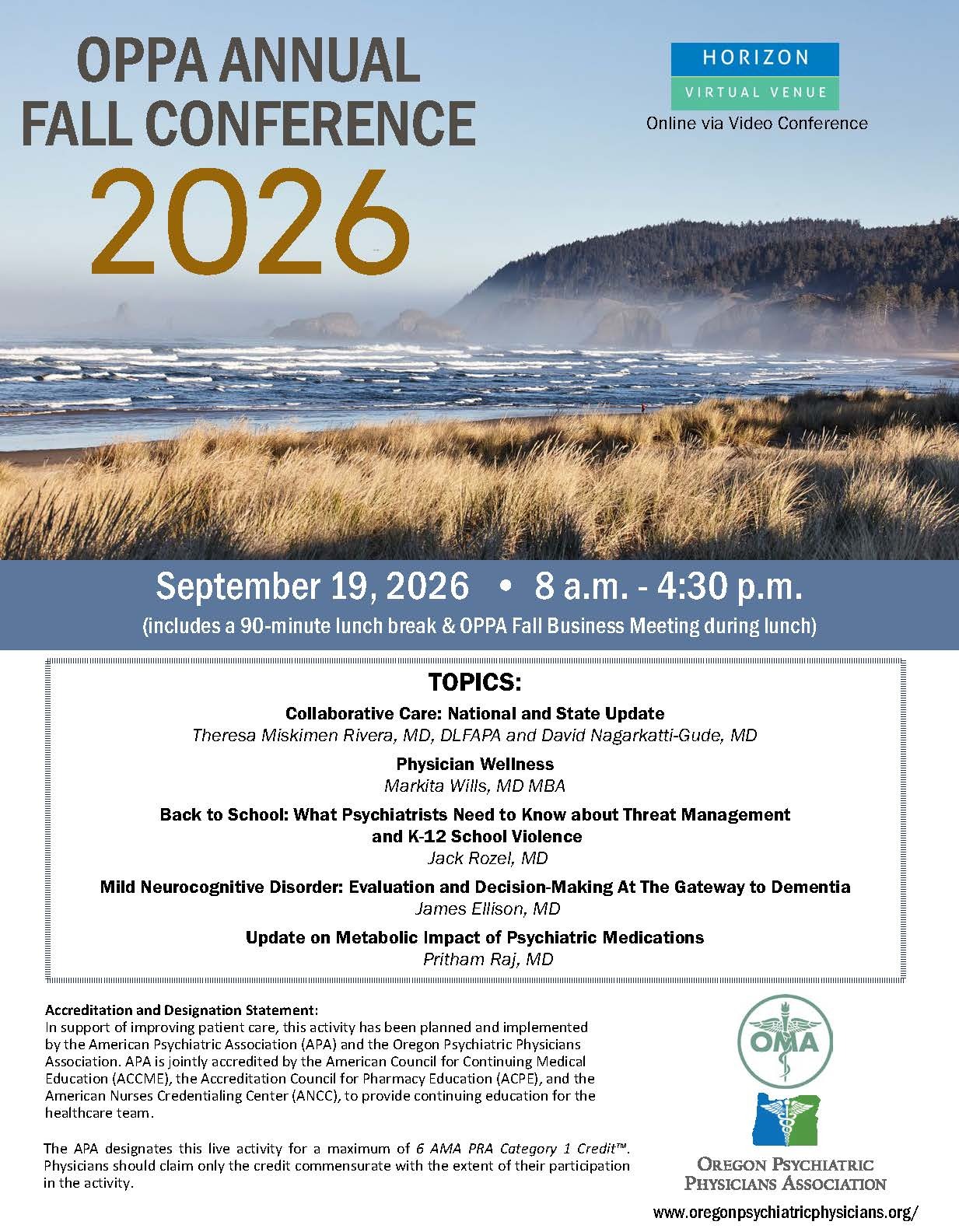
2026 Oregon Psychiatric Physicians Fall Virtual Business Meeting and CME Program
September 19th - virtual
Conference Fees:
General Attendee: $150
Trainee Member: (Med Students, Residents, Fellows): $50
Trainee Fees are reimbursed after attendance is verified.
DOWNLOAD FLYER
TARGET AUDIENCE: Physicians, Physician Associates, Nurse Practitioners of all specialties. Behavioral Health & Addiction practitioners (LCSW, LPC, CADC). Practitioners from all States welcome.
Accreditation and Designation Statement:
In support of improving patient care, this activity has been planned and implemented by the American Psychiatric Association (APA) and the Oregon Psychiatric Physicians Association. APA is jointly accredited by the American Council for Continuing Medical Education (ACCME), the Accreditation Council for Pharmacy Education (ACPE), and the American Nurses Credentialing Center (ANCC), to provide continuing education for the healthcare team.
The APA designates this live activity for a maximum of 6 AMA PRA Category 1 Credit™. Physicians should claim only the credit commensurate with the extent of their participation in the activity.
Saturday, September 19, 2026 | Tentative Virtual Conference Agenda: Download Agenda
| Time |
Session |
Presenter |
| |
| 8:00am |
Welcome - OPPA Council President |
Yetty Akins, MD
|
| |
|
|
| 8:10am |
“Mindfulness and Meditation” Contemplative Practices to Combat Burnout
Learning Objectives:
- Learn common applications of mindfulness-based therapies, and the disorders they are used to
treat.
- Understand practical applications of mindfulness-based therapies and treatments in clinical
setting.
- Evaluate when integrating mindfulness-based interventions into disaster/trauma psychiatry
response is most appropriate and how to do so effectively to support individual trauma recovery.
- Apply mindfulness strategies and techniques to your own life to reduce potential for burnout.
|
Marketa Wills, MD MBA
View Bio |
| |
|
|
| 9:10am |
10-minute Break |
|
| |
|
|
| 9:20am |
“Back to School: What Psychiatrists Need to Know about Threat Management and K-12 School Violence"
Learning Objectives:
- Distinguish targeted and stochastic violence
- Describe how psychiatrists can participate in school-based threat management
- Apply the pathway to intentional violence to evaluation and management
|
Jack Rozel, MD
View Bio |
| |
|
|
| 10:20am |
10-minute Break |
|
| |
|
|
| 10:30am |
“Mild Neurocognitive Disorder: Evaluation and Decision-Making at The Gateway to Dementia”
Learning objectives:
- Recognize the distinctions between normal cognitive aging, subjective cognitive impairment, mild neurocognitive disorder, and dementia (major neurocognitive disorder).
- Assess and diagnose mild neurocognitive disorder (MiND) according to its DSM5TR current definition.
- Intervene with diagnosis disclosure, decision making, planning, and appropriate management including disease modifying immunotherapy.
- Promote a “brain healthy” lifestyle for delay or prevention of cognitive decline.
|
James Ellison, MD
|
| |
|
|
| 11:30am |
Lunch Break and OPPA Business Meeting
|
|
| 1:00pm |
10-minute Break |
|
| |
|
|
| 1:10pm |
"Medical Updates for the Psychiatrist - Health Maintenance and Cardio metric Considerations"
Learning Objectives:
- Identify important medical updates for practicing psychiatrists
- Provide a more updated approach to Cardiovascular risks
- Identify AC/AHA guideline changes among several medical updates
|
Pritham Raj, MD
|
| |
|
|
| 2:10pm |
10-minute Break |
|
| |
|
|
| 2:20pm |
“Collaborative Care: National and State Update” and
Q+A Panel
Learning Objectives:
- Understand different pathways to reimbursement for Collaborative Care Model (CoCM) work in Oregon.
- Consider logistic and cultural hurdles to incorporating CoCM in an established health care system.
- Identify additional elements of primary care behavioral health integration that are independent from CoCM.
|
Theresa Miskimen Rivera, MD, DLFAPA and David Nagarkatti-Gude, MD
View Bios
|
| |
|
|
| 4:30pm |
End of Session |
|
 Invalid Quantity